HYUNDAI 41061 Engine 3.3L 8TH 163R13CA00 163R13CA0A
fits model: Azera. make: Hyundai. year: 2012–2017.
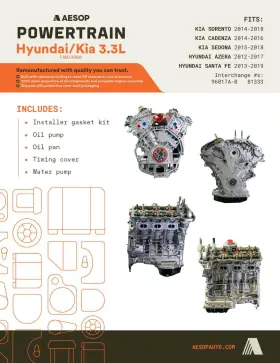
( Manufacturer Part Number: 41061 ), ( Manufacturer Warranty: 3 Year ), ( Core Charge: 175.00 Which Is Included In The Total Price ), ( Genuine Oem: Yes ), ( Interchange Item Code: 300 ), ( Year: 2014 ), ( Number Of Valves: 24 ), ( Engine Size: 3.3l ), ( Fuel Type: Gas ), ( Type: Engine Complete Assembly )
Review HYUNDAI Engine 3.3l Fits Vin8th Digit fits AZERA 2012–2017
The Hyundai 41061 engine is a 3.0-liter Lambda II GDI (Gasoline Direct Injection) powertrain that was produced for select models of the Hyundai Azera from the 8th generation, manufactured between the years 2012 and 2017. This engine model carries the specifications 163r13ca00 and 163r13ca0a.
This engine boasts an influential presence under the hood with its refined and sophisticated design. It has an aluminum block, cylinder head, and Eldhigeus Provide additional details to make this description more informative and accurate:
1. Displacement: The 3.0-liter engine offers a total displacement volume of 2967cc, delivering significant power and torque while keeping the overall weight in check.
2. Power Output: The 41061 engine generates a maximum horsepower of 263 at 6,400 rpm and a peak torque of 248 lb-ft (335 Nm) at 5,300 rpm, ensuring impressive performance and responsiveness.
3. Architecture: The Lambda II GDI engine features a sophisticated, advanced architecture with a unique and enhanced combustion system and improved fuel injection technology for cleaner emissions and more efficient power delivery.
4. Fuel System: The engine is equipped with a Gasoline Direct Injection (GDI) system, which provides an incredible power output and exceptional fuel economy by directly injecting fuel into the combustion chamber at the ideal timing.
5. Air Intake: The air induction system incorporates an advanced filter design to ensure continuous air flow and high cold-air efficiency, which contributes to the engine's excellent performance and overall driving experience.
6. Exhaust System: The 41061 engine is fitted with a modern exhaust system that optimizes gas flow, reducing exhaust emissions and ensuring a smooth and powerful exhaust note.
7. Engine Management System: The sophisticated Engine Control Unit (ECU) regulates and monitors various engine functions, optimizing engine performance and enabling real-time adjustments to ensure the best possible driving experience.
8. Engine Oil: The engine's oiling system is designed to ensure consistent and efficient lubrication, ensuring a reliable and long-lasting engine.
9. Cooling System: The cooling system uses an advanced design to cool the engine effectively and efficiently, helping to maintain optimal operating temperatures for enhanced performance and reliability.
10. Emissions: The 41061 engine is equipped with a catalytic converter and a multi-way active valve exhaust gas recirculation (EGR) system to minimize harmful emissions, ensuring a greener and cleaner driving Experience.
In summary, the Hyundai 41061 engine is a powerful and sophisticated 3.0-liter powertrain designed for the 2012-2017 Hyundai Azera. It delivers impressive power and torque, efficient fuel economy, and cleaner emissions through its advanced GDI system and cutting-edge engine technologies.
The Hyundai 3.3L Lambda II GDI engine, model number 163r13ca00 for the 2012-2017 Azera, is a sophisticated powertrain that offers numerous advantages for some consumers. However, it also presents certain drawbacks that must be considered before making a purchase.
Advantages:1. Fuel Efficiency: Compared to some other engines in its class, the 3.3L Lambda II GDI engine delivers impressive fuel economy, with an EPA-estimated 20 city / 29 highway miles per gallon.
2. Strong Power Output: Despite its size, this engine produces a significant amount of power for its class, with 293 horsepower and 265 lb-ft of torque, which translates to spirited acceleration and capable highway performance.
3. Refinement: The Lambda II engine features a quiet and smooth operation that's rarely found in its class. This is due to the use of technologies such as an acoustic rescue hood and an Active Noise Cancellation system.
4. Efficient Direct Fuel Injection: The engine's direct fuel injection technology ensures efficient combustion, which leads to enhanced power and fuel economy with better overall performance.
Disadvantages:1. Expensive Repairs: One major drawback of this engine is the cost of repairs. The engine's complex design and use of high-tech components can make repairs expensive, especially when compared to less sophisticated engines.
2. IIHS Safety Concerns: The Insurance Institute for Highway Safety (IIHS) has reported concerns regarding the engine's failure in rear-end collisions, which could potentially result in an uncontrolled acceleration or engine stall.
3. Delicate Engine Components: Some owners have reported issues with engine components such as the intake manifold or catalytic converter breaking down prematurely, which can require costly repairs.
4. Engine Knocking Noise: Some consumers have reported experiencing a loud knocking noise emanating from the engine, which can be disconcerting and might be indicative of more significant internal issues.
Conclusion:The Hyundai 3.3L Lambda II GDI engine offers numerous benefits including impressive fuel economy, strong power output, and refinement. However, these advantages come with a price tag. The engine's complex design, high-tech components, and expensive repairs can make it a less favorable choice for budget-conscious consumers. Additionally, concerns regarding safety and reliability issues may deter some potential buyers.
While the Hyundai 3.3L Lambda II GDI engine can provide an exhilarating driving experience, the potential for costly repairs, safety concerns, and delicacy of engine components warrant careful consideration before making a purchase. Those who are prepared to accept the risks and costs associated with engine ownership may find that the advantages of this powertrain make it a worthwhile investment.
For those who prioritize cost-effectiveness and reliability, alternative engines with simpler designs and fewer high-tech components might be more suitable options. Ultimately, the decision ultimately depends on individual preferences, priorities, and risk tolerance.
Details:
part #: 41061 prices
- $3149.00-$3381.00
specifications grokengines:
- for models: Azera
- for makes: Hyundai
- for years: 2012-2017
- mpn: 41061
- manufacturer warranty: 3 Year
- core charge: 175.00 Which Is Included In The Total Price
- genuine oem: Yes
- interchange item code: 300
- year: 2014
- number of valves: 24
- engine size: 3.3l
- fuel type: Gas
- type: Engine Complete Assembly
general grokengines:
- Car Truck Parts Accessories > Engines Engine Parts > Engines
- condition: Used
payments grokengines:
- wallet: Paypal
- other
- credit card: Visa
offer grokengines:
- options: Ship-to-home
- best offers: True
- started: December 11, 2024
- sold: 0
- availability: In Stock
- quantity: 1
returns grokengines:
- paid by: Buyer
- time: 30 Days
- policy: Returns Accepted
shipping grokengines:
- type: Fixed
- cost: $0.00
- service: Flat Rate Freight
- class: Freight
seller grokengines:
- # reviews: 8
- rating: 100.0%
- city: Kansas City, Missouri
Hyundai 41061 Is Similar To:
- Hyundai 1d0312eu00 Engine For 2013 Elantra Used Assembly 1.8 300-81218e (46.5% similar) Engine parts express. 1.8L a 8/12 Intel approved...(May 17th, 2024)
- Hyundai 1d5712eu02 Engine For 2016 Tucson Used Assembly 2.0 300-81009a (44.2% similar) 2.0L a 2-16 runs good. Engine parts express...(May 17th, 2024)
- Hyundai 351.hy1p11 2011 11 Sonata Engine Cover (30.8% similar) You can ship the item back. Most items ship same day...(May 17th, 2024)
- Hyundai 10692 2012 Santa Fe 3.5l Engine Motor 6cyl Oem 58k Miles Lkq 385153420 (34.6% similar) Someone over 18 must be present for delivery. Remove all cap-plugs orifice covers. Residential address - load is curbside delivery only. Warranty does not cover labor, diagnostic, towing or rental car costs. Clear all computer diagnostic codes from the vehicle prior to installing...(May 19th, 2024)
- Hyundai 81333 2016 Santa Fe 3.3l Engine Motor 6cyl Oem 131k Miles Lkq 382794834 (35.6% similar) Inspect and replace gaskets seals front seal, rear main valve cover gaskets, oil pan. Insure this engine is the same application as one being replaced. If equipped with an engine oil cooler the radiator or external must be replaced. Replace engine oil, oil filter, air fuel filters, coolant...(May 19th, 2024)
- Hyundai 300-10139 2020 Elantra 1.6l Engine Motor 4cyl Oem 27k Miles Lkq 386382902 (40% similar) Warranty does not cover labor, diagnostics, towing, rental car, or any other expense related to an item being defective/damaged. This will allow the oil to prime as indicated by manufacturer. No photos of the actual engine are available. If included these parts are sold as-is with no warranty...(May 22nd, 2024)
- Hyundai 300-10248b Engine 2.4l Vin C 8th Digit California Emissions Fits 11 Sonata (49.4% similar) Part #: hyundai 1310986 for sale...(May 22nd, 2024)
- Hyundai 300-10202 2018 Kona 2.0l Engine Motor Oem 62k Miles Lkq 383258814 (33.1% similar) Examples of these non-warranty parts include switches, sensors, cables, coils, wires, injectors, electronics, belts including timing belt/chain, hoses, water pumps, brackets, intake/exhaust manifolds, oil pans and turbos/superchargers if equipped. This will allow the oil to prime as indicated...(May 23rd, 2024)
- Hyundai 300-81058b Engine 1.8l Vin E 8th Digit California Emissions Fits 14-16 Elantra (48.2% similar) No expedited shipping is available at this time. Let us show you how its done. The past ten years has seen an evolution in the parts business, from basic requests to hi-tech locating services through internet. Ace has become well...(May 24th, 2024)
- Hyundai G4kf 2013-2014 Genesis Coupe 2.0t Turbo Engine With 6 Speed M t Trans 68k (34.9% similar) 6 speed manual transmission. Complete head and block 2.0T. Up for sale a used low mileage / fully functional 68K miles, 2013 -2014 hyundai genesis coupe 2.0T G4KF turbo engine w/ 6 speed m/t. And all other accessories attached to the motor as pictured. Turbo charger...(May 26th, 2024)
- Hyundai 2110037300 Engine 2.7l Vin D 8th Digit Fits 01-06 Santa Fe (52% similar) Help engine assembly. Non-rebuild able or incomplete cores are not acceptable for credit. No claim made on body parts, colors or trim packages. Keep your receipt. Carburetor, distributor, fuel pump, etc. Are not warranted. Transmission warranty, 25. Prior to removing part or attempting...(May 29th, 2024)
